
You spend weeks creating content. You optimize headlines. You distribute on social media. But the backlinks? They trickle in at a pace that makes glacial movement look fast.
Here's what most content creators miss: every broken link on someone else's website is a backlink opportunity for you. Broken link building is the strategy that turns other people's dead links into your competitive advantage — and it works because you're solving a real problem for the site owner while earning a high-quality link for yourself.
This guide walks you through the exact broken link building process — from finding target pages to sending outreach emails that actually get responses.
What Is Broken Link Building?
Broken link building is a white-hat SEO strategy based on a simple value exchange: you find dead links on other websites, then contact the site owner with a replacement link to your content.
The process works in five steps:
- Find resource-heavy pages in your niche (link roundups, blog rolls, recommended tools lists)
- Scan those pages for broken links — pages that return 404 errors, time out, or redirect to irrelevant content
- Evaluate the opportunities — is the linking site authoritative? Is the context relevant?
- Create replacement content that matches the original intent of the dead link
- Send a personalized email telling the site owner about the broken link and offering your replacement
The brilliance of this strategy is the incentive alignment. The site owner benefits from fixing a broken user experience. You benefit from earning a contextually relevant backlink. Readers benefit from working links. Everyone wins.
Why Broken Link Building Works in 2026
Link building has gotten harder. Guest post networks are penalized. PBNs are toxic. Comment spam is filtered. But broken link building continues to work because it's fundamentally helpful rather than manipulative.
The numbers back this up:
- 48% of SEO professionals actively use broken link building as part of their link acquisition strategy
- Resource pages accumulate broken links at a rate of 5-10% annually as sites shut down, pages move, and domains expire
- Outreach emails that report a specific problem (like a broken link) get 2-3x higher response rates than cold pitches
The link rot advantage: Studies consistently show that roughly 25% of web links break within two years. For resource pages with dozens of outbound links, that means multiple broken link building opportunities per page — and most of them have never been reported to the site owner.
Why site owners respond: Nobody wants broken links on their site. When you email a webmaster about a dead link, you're alerting them to a problem they might not know about. Adding a replacement suggestion is a natural extension of that helpful notification. You're not asking for a favor — you're offering a solution.
Search engine alignment: Unlike manipulative link schemes, broken link building creates genuine editorial value. The site owner makes a deliberate choice to link to your content. Google's algorithms are designed to reward exactly this kind of natural link acquisition.
Step 1: Find Target Pages in Your Niche
The quality of your broken link building campaign depends entirely on the pages you target. Not every page with broken links is worth pursuing.
Where to Find High-Value Target Pages
Resource pages and link roundups are your highest-value targets. These are pages specifically designed to link out to helpful resources. Search operators to find them:
"your niche" + "useful resources""your niche" + "recommended tools""your niche" + "link roundup""your niche" + inurl:resources"your niche" + inurl:links
Competitor backlink profiles reveal pages that already link to content similar to yours. If a page links to your competitor, it might also link to you — especially if you can find broken links on the same page.
Blog rolls and sidebar links on niche blogs often contain outdated links to tools or resources that no longer exist. These are easy fixes for the site owner and easy wins for you.
University and government resource pages carry exceptional domain authority. Educational institutions frequently maintain resource lists that go years without maintenance, accumulating broken links that represent high-value opportunities.
Qualifying Your Targets
Not every page deserves your time. Before scanning for broken links, evaluate the target:
| Signal | Why It Matters |
|---|---|
| Domain authority (DA 30+) | Higher authority = more valuable backlink |
| Topical relevance | Contextually relevant links carry more SEO weight |
| Page freshness | Recently updated pages suggest active maintenance |
| Number of outbound links | More links = higher probability of dead ones |
| Link placement | Editorial links in content > sidebar or footer links |
A resource page on a DA-50 education site with 40+ outbound links is a far better target than a random blog post with five links, even if both have broken links.
Step 2: Scan Pages for Dead Links at Scale
Finding individual broken links by clicking through pages is painfully slow. You need a systematic approach that checks hundreds of links across dozens of pages.
The Manual Approach (Don't Do This)
Manually clicking every link on a target page takes 30-60 minutes per page. At that rate, you'd spend an entire workday checking just 8-16 pages — far too slow for a viable link building campaign.
The Scalable Approach: Batch Link Checking
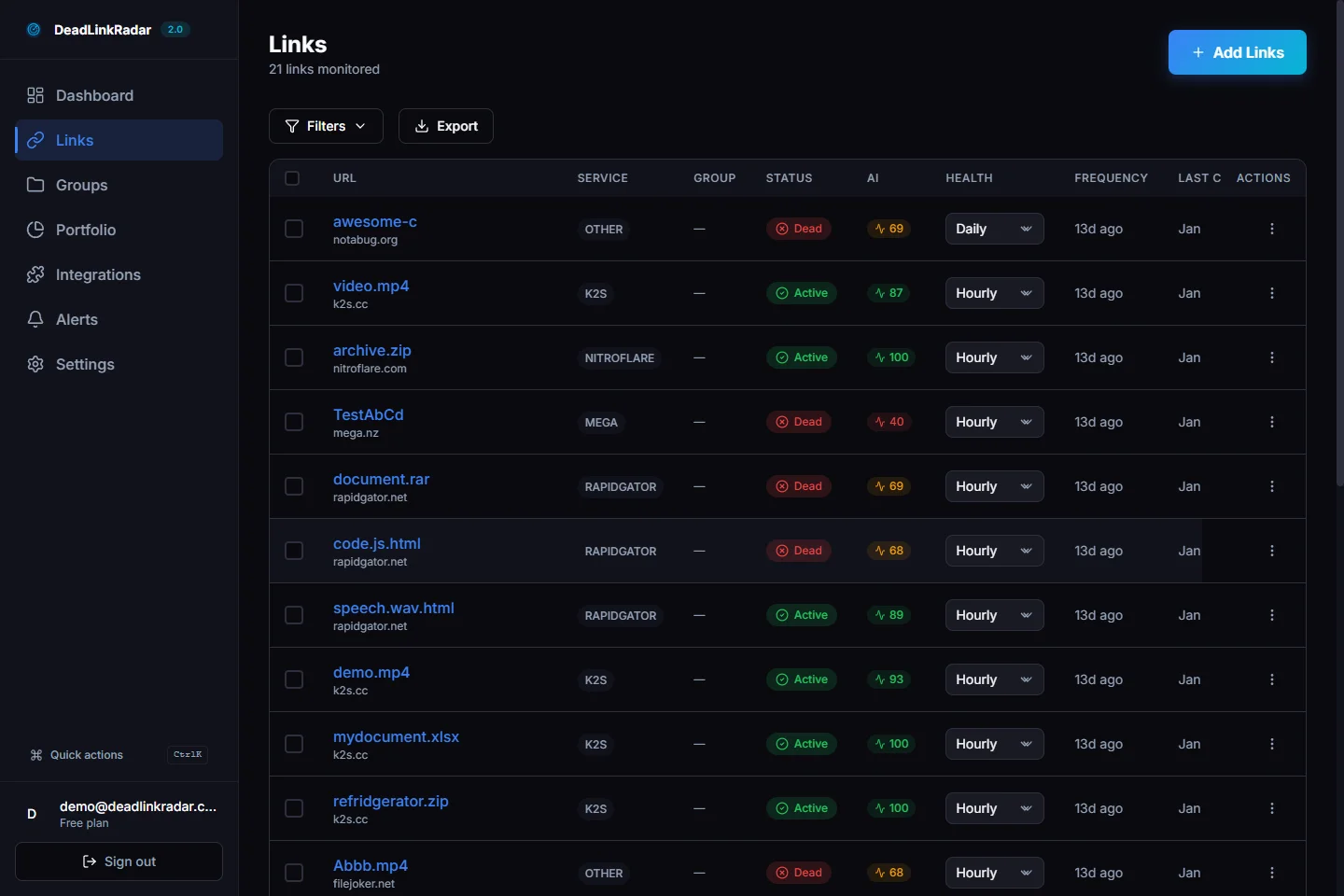
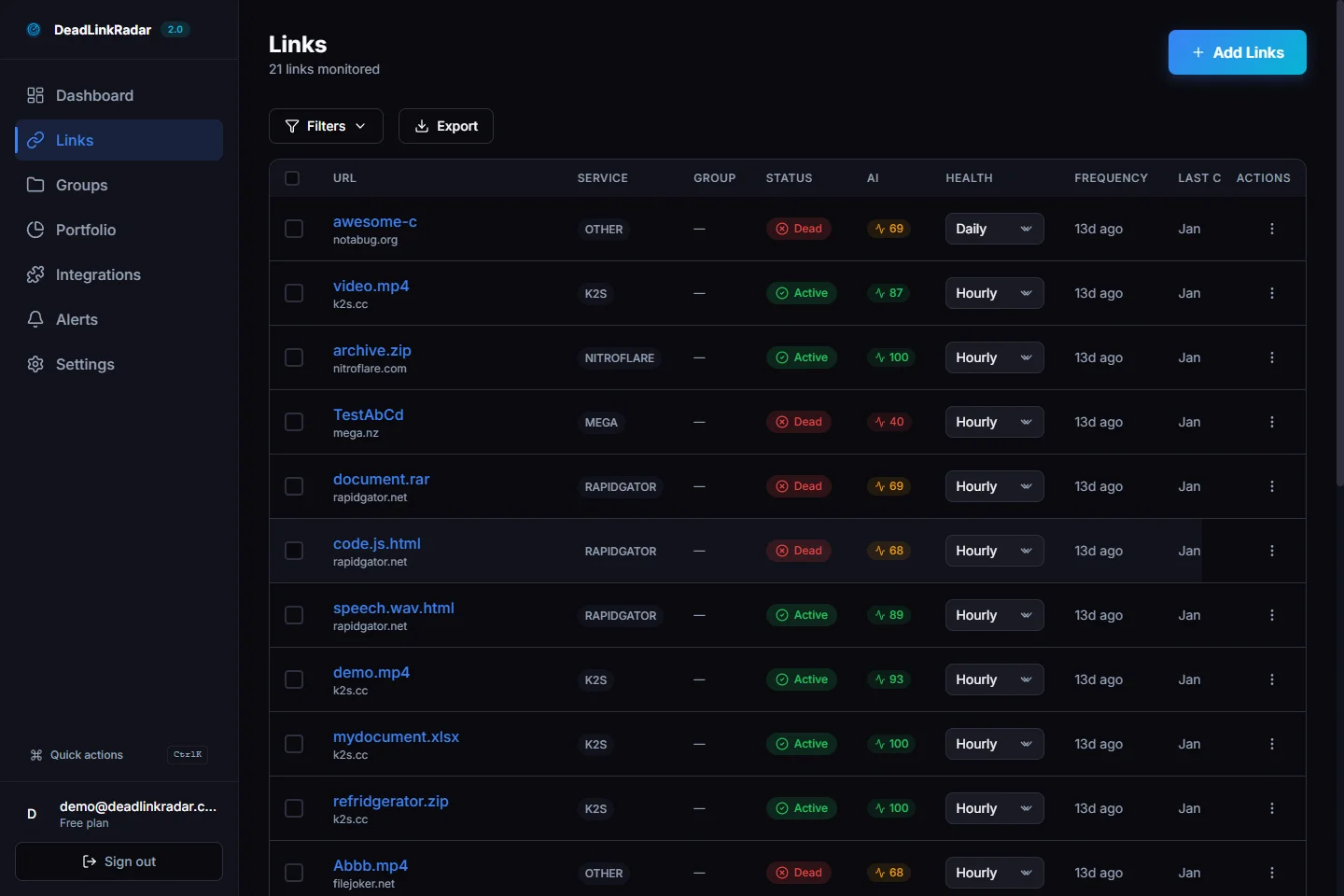
A dedicated broken link checker lets you paste URLs in bulk and get instant status reports. Instead of clicking links one by one, you feed the tool a list of URLs from your target pages and get results in minutes.
What to look for in your scan results:
- 404 Not Found — The page is gone. This is your clearest opportunity
- Timeout errors — The server isn't responding. The domain may have expired
- Redirect to irrelevant content — The URL now points somewhere completely different from the original intent
- Soft 404s — The page loads but shows a "page not found" message or placeholder content instead of real information
Soft 404 detection is especially important. Many broken pages technically return a 200 OK status but display "this page has been removed" or "content no longer available." Basic link checkers miss these entirely, but AI-powered analysis can identify them by evaluating page content rather than just status codes.
Building Your Prospect List
For each broken link you find, record:
- The target page URL (the page containing the broken link)
- The broken link URL (the dead destination)
- The anchor text used for the broken link
- The context — what topic was the broken link about?
- The site owner's contact info (find the contact page or author bio)
This data becomes your outreach spreadsheet. The anchor text and context are crucial because they tell you exactly what kind of replacement content the site owner needs.
Step 3: Evaluate Which Opportunities Are Worth Pursuing
Not every broken link is worth chasing. Spending time on low-value opportunities dilutes your effort and reduces your campaign's return on investment.
The Opportunity Scoring Framework
Rank each broken link opportunity on three dimensions:
Authority (1-5): How authoritative is the linking page?
| Score | Criteria |
|---|---|
| 5 | DA 60+, established brand, high-traffic page |
| 4 | DA 40-59, recognized niche site |
| 3 | DA 20-39, active blog with regular updates |
| 2 | DA 10-19, small site but relevant niche |
| 1 | DA <10, low traffic, questionable quality |
Relevance (1-5): How closely does the broken link's topic match your content?
| Score | Criteria |
|---|---|
| 5 | Exact topic match — your content is a perfect replacement |
| 4 | Strong overlap — minor adjustments make it fit |
| 3 | Related topic — you could create content to match |
| 2 | Tangential connection — weak fit |
| 1 | Unrelated — don't waste your time |
Effort (1-5): How much work is needed to create a valid replacement?
| Score | Criteria |
|---|---|
| 5 | Content already exists on your site |
| 4 | Minor update to existing content needed |
| 3 | New section or expansion required |
| 2 | Significant content creation needed |
| 1 | Complete new piece required from scratch |
Prioritize opportunities that score 10+ total across all three dimensions. A DA-50 page with an exact-match broken link where you already have replacement content? That's a 15/15 — pursue it immediately.
Using AI Confidence Scoring
Modern link analysis tools go beyond simple dead-or-alive status checks. AI-powered confidence scoring evaluates the likelihood that a link is genuinely broken versus temporarily unavailable or misconfigured.
A high confidence score (90%+) means the link is almost certainly dead and won't come back. A lower score (50-70%) might indicate temporary server issues or intermittent problems that could resolve on their own.
Focus your outreach on high-confidence broken links. There's nothing worse than emailing a site owner about a "broken" link that works perfectly fine when they check it. That destroys your credibility and kills any chance of earning the backlink.
Step 4: Create Replacement Content That Wins
Your replacement content needs to be genuinely better than what existed at the broken URL. Site owners aren't going to swap a link just because you asked — they need to see that your content serves their readers.
Match the Original Intent
Before writing anything, understand what the original broken page was about. Use the Wayback Machine (web.archive.org) to find cached versions of the dead page. Study:
- The topic coverage — What did the original page explain?
- The depth — Was it a quick overview or an in-depth guide?
- The format — Was it a list, tutorial, tool, or reference page?
- The audience — Beginner, intermediate, or expert?
Your replacement should match all four dimensions while adding more value.
The Upgrade Strategy
Simply matching the original content isn't enough. You need to upgrade it:
- Add fresher data — Update statistics, case studies, and examples to 2026
- Improve formatting — Better headings, tables, visual aids, and scannable structure
- Expand coverage — Cover aspects the original missed
- Include visuals — Screenshots, diagrams, and charts that didn't exist in the original
- Fix technical accuracy — Correct any outdated or incorrect information
The "10x replacement" mindset: If the original broken page had 500 words on the topic, aim for 1,500-2,000 words with visual aids. If it had basic coverage, add advanced tactics. Make the site owner feel like they're upgrading their resource page by linking to you.
Content Templates by Opportunity Type
| Broken Link Type | Replacement Content Strategy |
|---|---|
| Dead tool/product page | Create a comparison or alternative guide |
| Expired blog post | Write a comprehensive updated version |
| Removed research/study | Compile newer data on the same topic |
| Defunct resource list | Create your own updated resource list |
| Dead infographic | Design a fresh visual with current data |
Step 5: Send Outreach Emails That Get Responses
Your outreach email is the make-or-break moment. Everything you've done — finding targets, scanning links, creating content — leads to this single interaction.
The Broken Link Building Email Template
Subject line: Quick heads-up: broken link on [Page Title]
Hi [Name],

I was reading your [resource page / article] on [topic] and noticed
that the link to [anchor text / description] appears to be broken.

The URL [broken URL] is returning a 404 error.

I recently published a [guide / resource / tool] covering [topic]
that might work as a replacement:

[Your URL]

Either way, wanted to let you know about the broken link. Hope
this helps!

[Your name]
Why This Template Works
- Short — Busy people scan emails. This takes 15 seconds to read
- Helpful first — The broken link notification comes before the pitch
- Low pressure — "Might work as a replacement" is a suggestion, not a demand
- Specific — The exact broken URL and page title show you actually visited their site
- No fake urgency — No "respond within 48 hours" nonsense
Personalization Tips
Generic emails get ignored. Personalized emails get responses. Add one sentence that proves you actually read their content:
- "Your section on [specific topic] was particularly helpful"
- "I noticed you also cover [related topic] which is something I write about"
- "Your resource list is one of the most comprehensive I've found for [niche]"
Never lie about reading their content. If you haven't read it, say something neutral like "I came across your resource page while researching [topic]."
Follow-Up Cadence
Most successful outreach campaigns require follow-up. The first email has a 5-15% response rate. Adding follow-ups can double or triple that.
| Timing | Approach | |
|---|---|---|
| Initial outreach | Day 0 | Report broken link + suggest replacement |
| Follow-up 1 | Day 5-7 | Brief nudge: "Just following up on the broken link I mentioned" |
| Follow-up 2 | Day 14 | Final check-in, mention you found another broken link if applicable |
Stop after three emails. More than that becomes spam. If they haven't responded after three well-timed emails, move on to the next opportunity.
Tracking Your Outreach
Keep a simple spreadsheet tracking:
| Column | Purpose |
|---|---|
| Target URL | The page with the broken link |
| Contact email | Who you're emailing |
| Date sent | When you sent the initial email |
| Follow-up dates | When follow-ups were sent |
| Response | What they said (if anything) |
| Outcome | Link placed / Declined / No response |
This tracking data becomes invaluable over time. You'll see which types of sites respond best, which email variations work, and what your actual conversion rate looks like.
Common Mistakes That Kill Your Success Rate
Broken link building is simple in concept but easy to mess up in execution. These are the most common mistakes that tank response rates.
Mistake 1: Mass Emailing Without Personalization
Sending identical emails to 500 site owners is spam, not outreach. Even with a working template, every email needs at least one personalized element — the page title, a specific observation about their content, or a reference to their niche focus.
The fix: Quality over quantity. Ten personalized emails outperform 100 generic ones.
Mistake 2: Offering Irrelevant Replacement Content
If the broken link was about "beginner Python tutorials" and you offer a replacement about "advanced machine learning algorithms," the site owner has no reason to use your link. The replacement must match the original context.
The fix: Use the Wayback Machine to understand the original content's intent. Create content that serves the same audience and purpose.
Mistake 3: Targeting Low-Authority Pages
Spending hours finding broken links on DA-5 blogs with 100 monthly visitors produces backlinks that barely move the needle. Your time is better spent on fewer, higher-authority opportunities.
The fix: Set a minimum domain authority threshold (DA 20-30 depending on your niche) and skip everything below it.
Mistake 4: Reporting Links That Aren't Actually Broken
If you email someone about a "broken link" that works when they click it, your credibility is destroyed. This happens when link checkers flag temporary server issues or when sites use geographic restrictions.
The fix: Use a link checker with AI-powered confidence scoring that distinguishes genuinely dead links from temporary issues. Verify high-priority opportunities manually before sending outreach.
Mistake 5: Giving Up After One Campaign
Broken link building compounds over time. Your first campaign might yield a 5% success rate. By your fifth campaign, you'll have refined your template, know which site types respond, and have a library of replacement content ready to go. The success rate climbs to 15-25%.
The fix: Commit to at least three full campaigns before evaluating whether broken link building works for your niche.
Mistake 6: Ignoring Soft 404s
A link that returns a 200 status code but displays "This page has been removed" or a generic placeholder is just as broken as a 404. Most basic link checkers miss these, which means most link builders ignore them.
The fix: Use a link analysis tool with content-based detection that identifies soft 404s, login walls, and redirect traps. These represent untapped opportunities that your competitors aren't finding.
Key Takeaways
Broken link building works because it creates genuine value for everyone involved. Here's what to remember:
- Find the right targets — Resource pages, link roundups, and high-authority niche sites offer the best opportunities
- Scan at scale — Manual checking is too slow. Use a batch link checker to process hundreds of URLs efficiently
- Evaluate before you pitch — Score opportunities by authority, relevance, and effort required. Focus on 10+ scoring opportunities
- Create upgraded content — Don't just match the original. Make your replacement visibly better
- Personalize every email — One specific observation about their site transforms your pitch from spam to helpful notification
- Follow up strategically — Three emails, spaced appropriately, without being pushy
- Use AI-powered detection — Soft 404s and confidence scoring help you find opportunities others miss and avoid embarrassing false positives
The websites with the most broken link building potential are the ones nobody else is checking. Resource pages in your niche are accumulating dead links right now. Every day you wait, a competitor could find those same opportunities first.
Start scanning for broken link building opportunities today. Import your target URLs, identify the dead links, evaluate the highest-value prospects, and send your first outreach batch this week. The backlinks won't build themselves — but with the right process, they'll come faster than you expect.