
You can publish great content, earn high-quality backlinks, and still watch your rankings slowly erode. In many cases, the culprit isn't your writing or your link profile — it's broken links that Google uses as evidence your site has let its quality slip. Running a broken link checker on your site regularly isn't just housekeeping. It's a direct way to protect one of the most influential signals in modern SEO: E-E-A-T.
Google's E-E-A-T framework (Experience, Expertise, Authoritativeness, Trustworthiness) shapes how search quality evaluator guidelines direct human reviewers and, by extension, how Google's systems assess your content. Of the four signals, Trustworthiness is the one most directly undermined by link health — and the one site owners most often overlook.
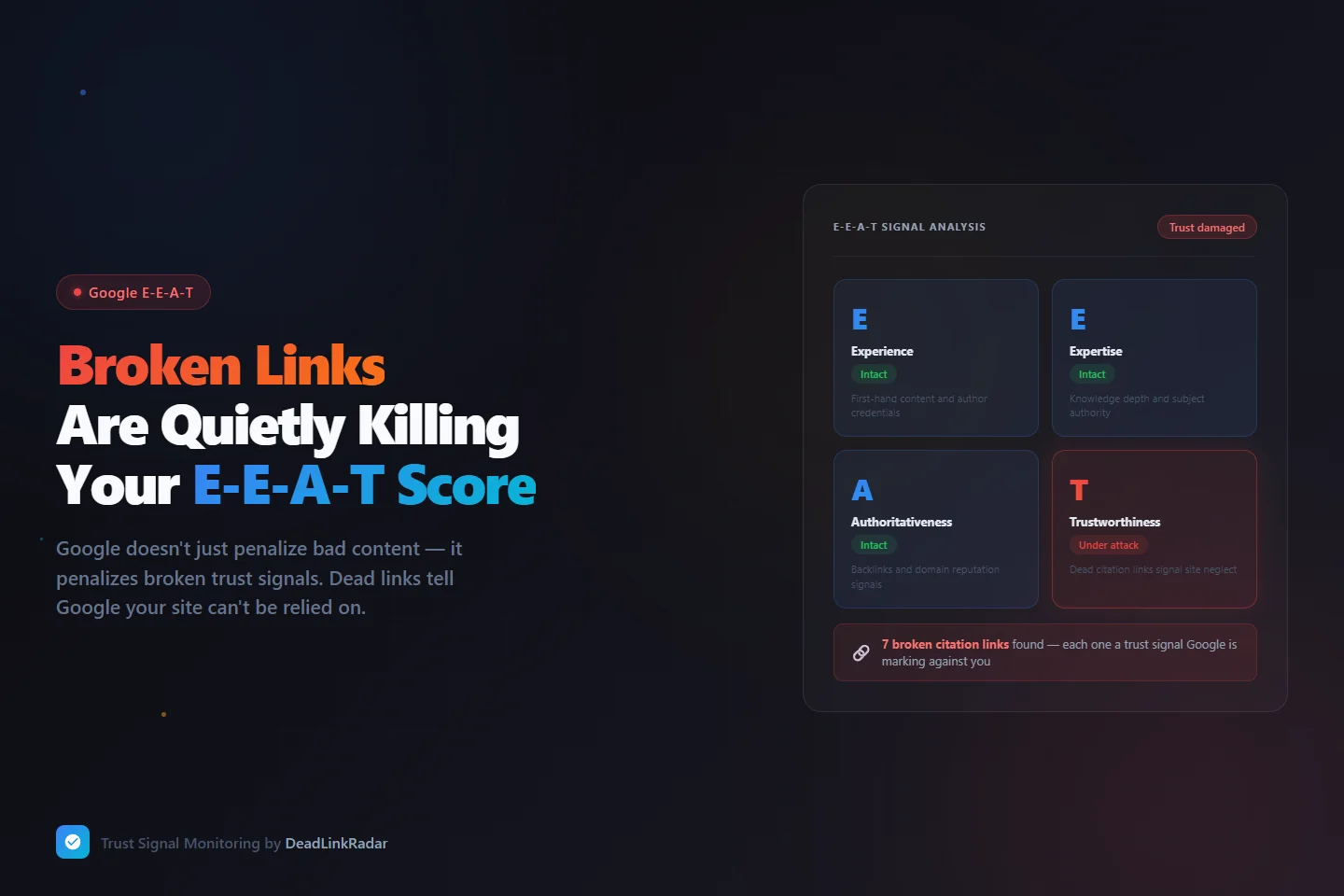
What E-E-A-T Actually Measures
E-E-A-T isn't a direct ranking signal in the traditional sense — there's no score Google openly publishes. Instead, it's a framework that shapes how Google trains its quality evaluators and models, which in turn influences whether your pages get surfaced for high-value queries.
The four components mean different things in practice:
| Signal | What Google Is Assessing | Where It Shows Up |
|---|---|---|
| Experience | Has the author actually done what they're describing? | Author bylines, first-person examples, case studies |
| Expertise | Is this content written by someone with relevant knowledge? | Author credentials, depth of coverage, accuracy |
| Authoritativeness | Is this site recognized as a credible source? | Backlinks from trusted domains, brand mentions |
| Trustworthiness | Can users and Google rely on this site? | Site maintenance, accurate information, working links |
The Trustworthiness component is broad by design. Google's quality evaluator guidelines use phrases like "accurate, honest, safe, and reliable" to describe trustworthy sites. A site with broken citation links — especially in content meant to inform or guide — fails on the "reliable" dimension before a single user even reads the page.
It's also worth understanding how these signals interact. You can have strong Expertise (well-researched content written by a credible author) and still undermine it through poor Trustworthiness signals. Google doesn't average these signals — low Trustworthiness can suppress a page even when the other three signals are solid. That's why link health matters so much in this framework: it's one of the few Trustworthiness indicators you can systematically measure and fix.
How Broken Links Send Trust Signals to Google
Google crawls your site regularly. When Googlebot encounters a link that returns a 404 or loops through a redirect chain that ultimately fails, it records that. Over time, a pattern of broken links on a domain tells Google's systems the site isn't being actively maintained.
This matters more than most people expect for three reasons:
Citations without destinations undermine your claims. If you write a blog post that cites a study, a tool, or a reference guide — and that link is broken — you've made a claim you can no longer substantiate. Google's evaluators are trained to look for this kind of evidence. A broken citation is like a footnote that goes nowhere.
External links are voluntary trust relationships. When you link out to another resource, you're implicitly endorsing it. If that resource has since been taken down, moved, or replaced with different content, you're pointing readers toward a dead end. At best it's an unpleasant user experience; at worst, it signals you haven't checked your sources since you published.
Neglected link profiles are an indirect signal of stale content. Google doesn't know exactly when you last updated a post, but it can infer site maintenance patterns from crawl data. A high density of broken external links suggests the content hasn't been maintained — which is a Trustworthiness flag, not just a hygiene issue.
The compounding effect is the real problem. A single broken link on a well-maintained site is noise. A dozen broken links across your top-performing guides is a pattern — and patterns are exactly what quality evaluator guidelines are designed to identify.
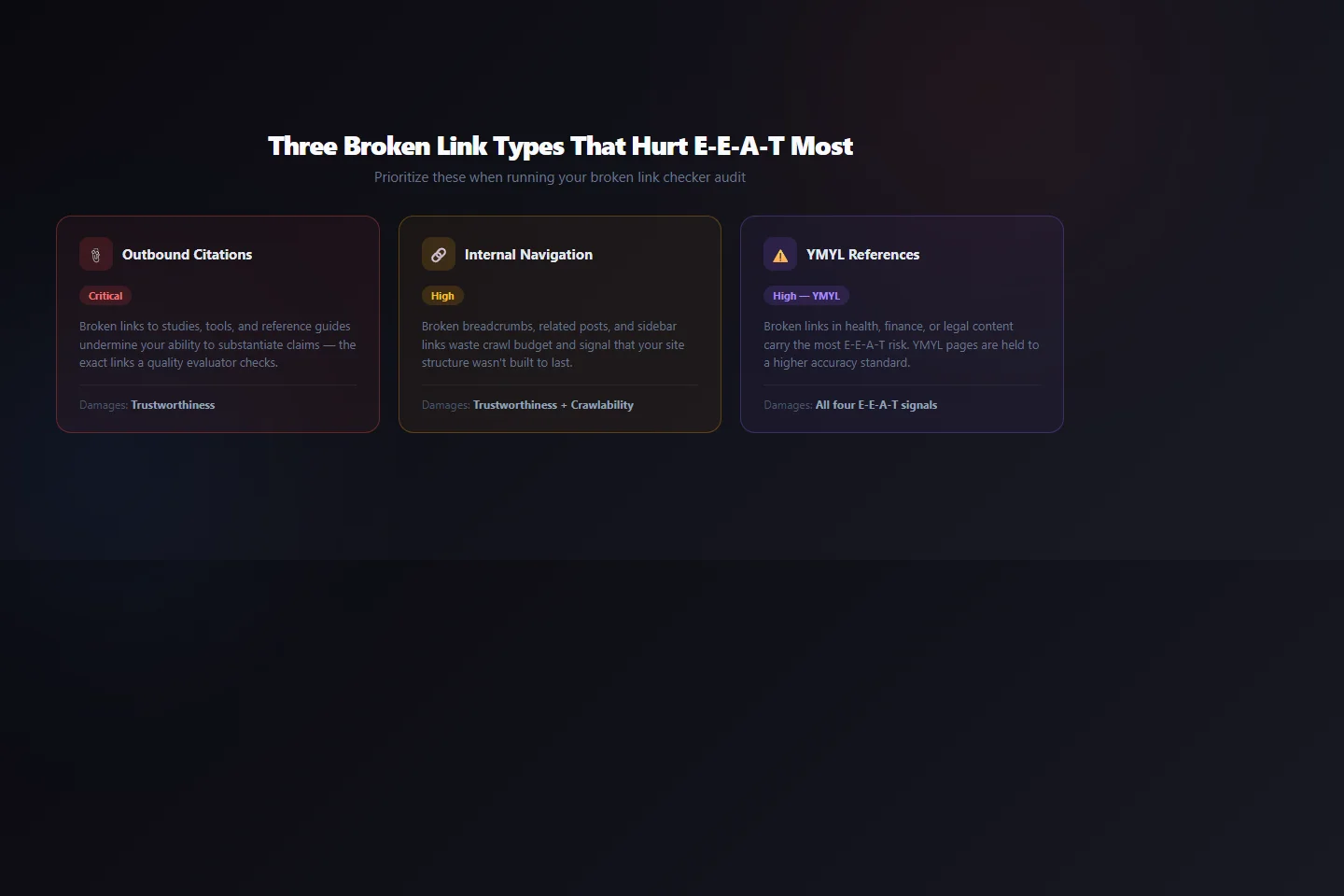
Three Link Types a Broken Link Checker Should Flag First
Not all dead links carry the same weight. Here's how to prioritize your audit when you run a broken link checker against your site:
Outbound Citation Links in Evergreen Content
Guides, tutorials, and cornerstone articles often cite studies, tools, official documentation, and reference materials. These are the links that matter most for Trustworthiness because they're the exact links a human quality evaluator would click to verify your claims.
A broken citation in a post about "the best ways to improve site speed" — pointing to a study or tool that no longer exists — directly undermines the credibility of everything else in that post. The more citations a piece has, the higher the risk of link rot over time. Evergreen content is particularly vulnerable because it's published once and rarely fully reviewed.
This is especially relevant for content that includes statistics. If you cite "47% of users expect a page to load in under two seconds" and the link points to a dead page, you've made an unverifiable claim. That's a direct Trustworthiness signal — your content makes statements it can no longer back up.
Navigation and Internal Links in High-Traffic Sections
Broken internal links damage user experience first, but they also send Googlebot into dead ends. If your site architecture points internal links toward pages that no longer exist — moved pages that weren't redirected, deleted tags or categories, retired product pages — you're wasting crawl budget and creating a navigation experience that suggests your site wasn't built to last.
For E-E-A-T purposes, internal navigation signals whether the overall site is coherent and intentional. Broken internal links in critical navigation areas (breadcrumbs, related posts, documentation sidebars) are more damaging than a broken link buried in a footnote.
When you check for broken links, internal links are often overlooked because site owners assume their own content is under control. In practice, site migrations, CMS changes, and slug updates create internal link rot just as quickly as external sources going offline.
Outbound Links in YMYL Content
YMYL (Your Money or Your Life) topics — health, finance, legal advice, safety — are held to a much higher E-E-A-T standard. If you publish content in these categories, any broken link to a medical reference, a regulatory page, or a financial institution carries disproportionate weight.
Google's guidelines explicitly mention that YMYL content requires a higher level of accuracy and trustworthiness. A broken link in a post about medication dosages or tax filing deadlines isn't just a maintenance problem — it's a credibility failure that signals the page can't be trusted to keep its references accurate.
Run a Broken Link Checker Audit in Four Phases
The starting point is a complete inventory of your outbound and internal links, segmented by the priority categories above. A structured audit approach gives you the most impact with the least effort.
Phase 1: Identify high-priority pages. Start with your most-linked-to content (check Google Search Console for your top-performing pages), your evergreen guides and tutorials, and any YMYL-adjacent content. These are the pages where broken links cause the most E-E-A-T damage. Don't start with your oldest posts — start with your most valuable ones.
Phase 2: Run a complete link check. For each high-priority page, check all outbound links for status. A link returning 200 is healthy. Redirects (301/302) to valid destinations are acceptable, though excessive redirect chains add latency. A 404, 410, 5xx error, or redirect that loops or fails are all problems to address.
Phase 3: Triage your findings. Not every broken link requires immediate action. Sort by: page traffic × link type × content category (YMYL or not). A broken citation in your most-visited guide ranks higher than a broken reference in a four-year-old post with 10 visits a month.
| Priority | Situation | Action |
|---|---|---|
| Critical | Broken citation in top-traffic evergreen guide | Fix immediately |
| High | Broken internal navigation link | Fix within the week |
| High | Broken YMYL reference | Fix immediately |
| Medium | Broken link in older, lower-traffic post | Fix in next batch pass |
| Low | Broken link in archived content | Review, may leave as-is |
Phase 4: Fix, replace, or remove. For each broken outbound link, find an equivalent resource — updated URL, an archived version via Wayback Machine, or a current alternative — and update the link. If no valid replacement exists, remove the citation and revise the claim that depended on it. Don't leave the broken link in place with a "see also" note — remove it entirely.
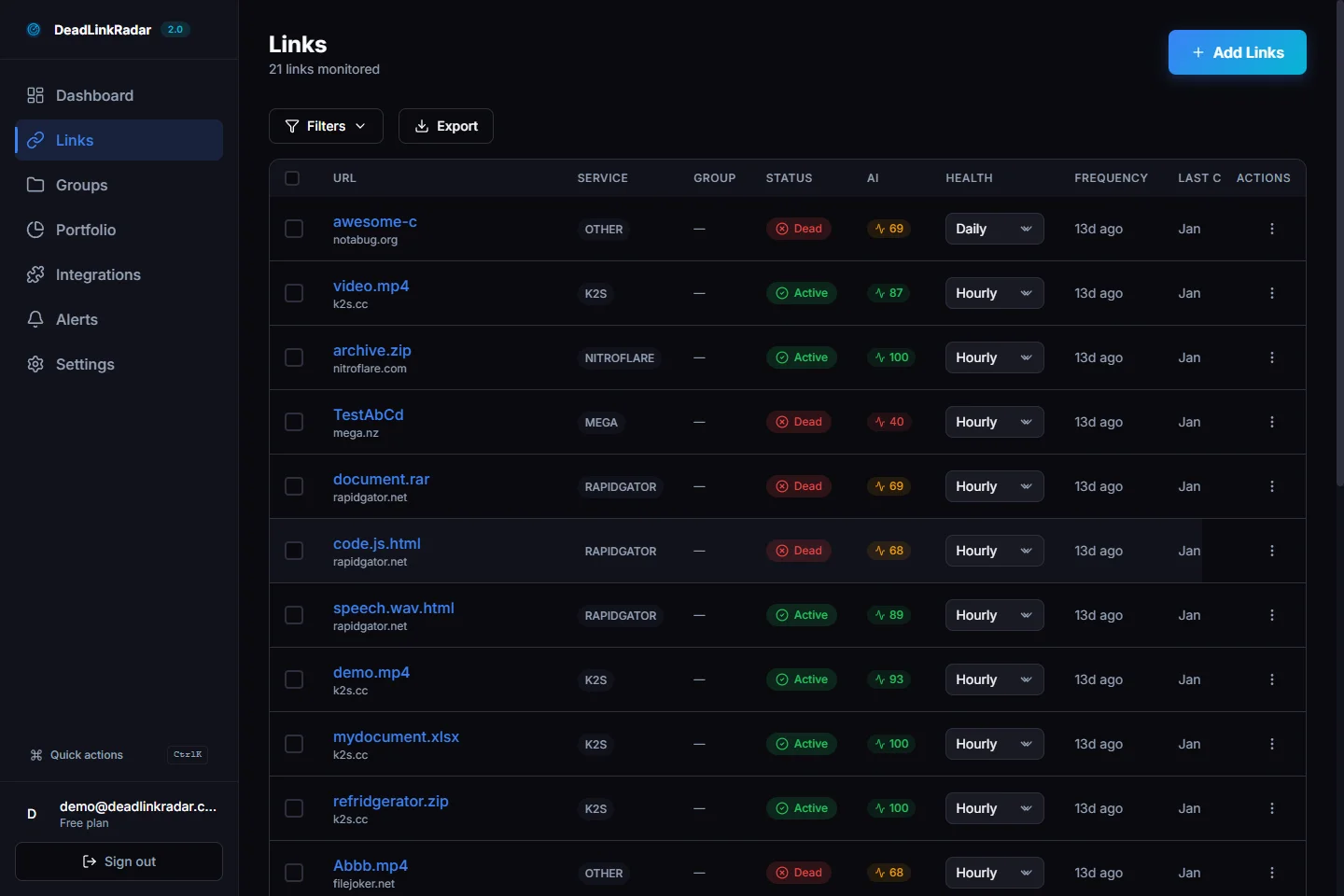
With DeadLinkRadar, we automate Phase 1 and Phase 2 continuously, so you're not running one-time audits that go stale the moment a linked resource goes down.
Continuous Monitoring to Prevent E-E-A-T Decay
The fundamental problem with one-time audits is that link rot is continuous. External sites go down, pages get moved, resources expire — and your previously healthy site slowly accumulates broken links between audits. A site that passed its annual link check in January can have a dozen broken citations by March, and none of them will surface until the next manual review.
E-E-A-T is not a score you achieve and maintain passively. It's a signal that requires active site maintenance. The sites that perform best on trust-sensitive queries tend to be those that treat content maintenance as an ongoing process, not an annual task.
Continuous monitoring gives you:
- Immediate alerts when an external link you cite goes dead, so you can fix or replace it before Googlebot recrawls the affected page
- Trend visibility across your link portfolio, so you can see which sections of your site accumulate broken links most quickly
- Historical records that show when and why a link broke — useful when deciding whether to find an equivalent source or revise the content that referenced it
The goal isn't a perfect site. It's a site that responds to problems faster than they accumulate — which is exactly what Trustworthiness, in Google's framework, is meant to measure. A site that catches and fixes a broken citation within 48 hours sends a very different signal than one that lets the same link sit dead for six months.
What to Do With Your Findings
Once you've completed your initial broken link check, prioritize actions in this order:
- Fix broken citations in evergreen guides — these have the highest E-E-A-T impact because they directly undermine the verifiability of your content
- Redirect or repair broken internal navigation links — protects crawl budget and user experience simultaneously
- Update broken YMYL references — highest credibility risk per broken link
- Review and remove broken links in older, lower-traffic posts — lower priority but worth addressing in batches
If you find that a significant portion of your content relies on external citations, set up monitoring so you're notified the moment those sources break. The difference between a site with strong Trustworthiness signals and one that gradually loses ground in search is often just this: one site knows when its links break, and the other finds out months later.
DeadLinkRadar monitors your full link portfolio in real time and sends alerts the moment something breaks — so your E-E-A-T signals stay intact without manual effort.
Make Your Broken Link Checker Work for Long-Term Rankings
The sites that maintain strong E-E-A-T over time share one habit: they check for broken links regularly, not reactively. Every piece of content you publish is a commitment to keep it accurate and navigable. That commitment includes the outbound links you've added as citations, the internal links you've built for navigation, and the resource links you've included to add value for readers.
Using a broken link checker as part of your ongoing site maintenance — not just a one-time cleanup — is the operational difference between a site that accumulates trust over time and one that erodes it. Google's systems are evaluating your site's reliability on every crawl. The most reliable signal you can send is a link portfolio that works.
Start monitoring your link health with DeadLinkRadar and make sure every broken link checker alert turns into a fix, not a footnote.